|
4-Chess - Adversaries and Allies
is a very entertaining and fun game suitable for families and friends.
It was created as
a life-imitating variant
to an already popular 4-player chess variant. It aims to be
very
intuitive for two-player chess players new to
four-player chess in that
all the standard rules apply,
and only a few extra rules are needed because four players are involved.
|
| The Board:
The
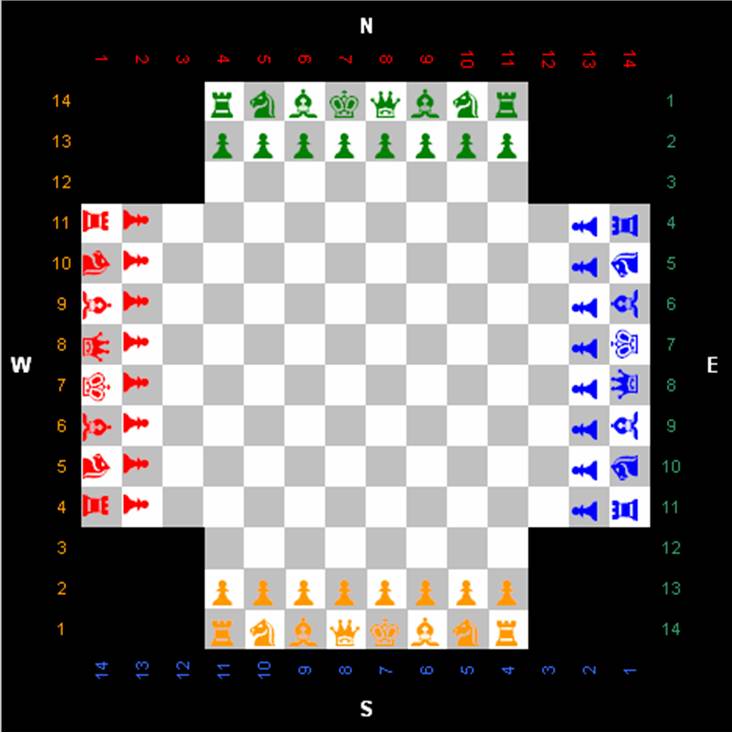
now near-standard four-player, 14-row, 160-square board is used as
depicted to the right. This is a standard 8x8 chess board with
three rows added on each edge to accommodate the two extra players and
increase the playing area. The board design is at least 300
years old, and no board manufacturer today holds a patent or copyright on
it. Note that the board corners are not used.
|
 |
 |
Setup:
The pieces are set on the board as depicted to
the left. Players choose whatever color they like. in whatever order
they like. There are no standard colors for 4 player chess, other
than each color should be distinctive.
The standard 2-player colors of black and white
generally are avoided because they carry too much 2-player baggage, such
as white always starts, players switch colors each new game, and white and
black are always adversaries.
In 4-player chess, players can keep the same
color every game,, start rotates with each new game, and any or all other players may
be your ally or your adversary.
The addition of another set of players more than
quadruples the complexity of the game, and each player must be especially
mindful of the added danger from the players on each side.
Play may be clockwise or
counter-clockwise. It is a good idea to switch play direction each new
game.
|
| Starting Configurations:
The normal setup for two-player chess is queens
on their own color facing each other. This is NOT used in four
player chess -- because the occurrence of another set of players destroys
the symmetry of the pieces and introduces a bias (unfairness) favoring the
player moving first and disfavoring the player moving last.
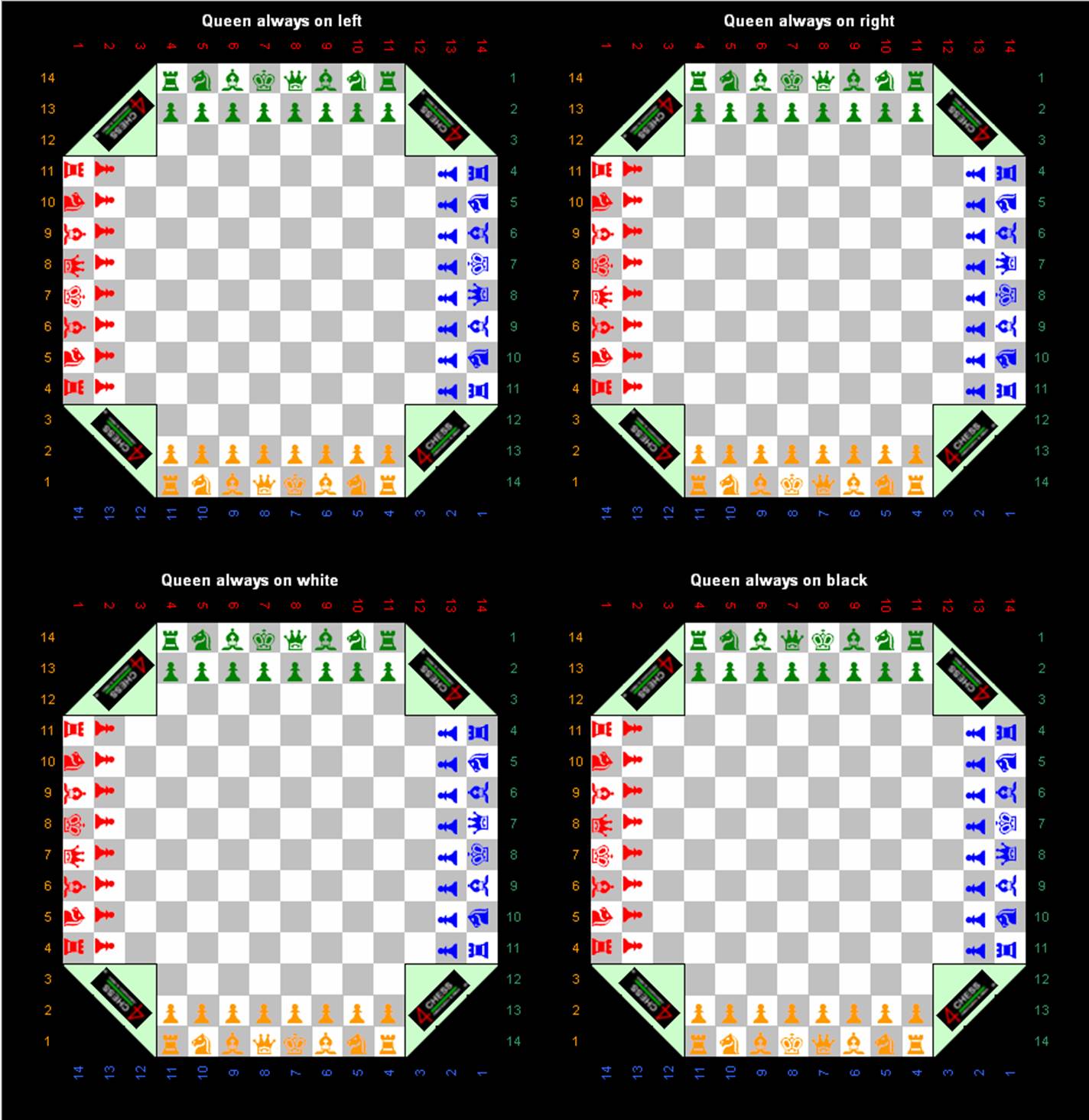
Instead, queens may either all be placed on
the same color, or all go on the left (or right) of the king. When
any of these four starting configurations are used, all players have an
equal chance of winning, These four fair (unbiased) starting
configurations are depicted below.
|
 |
PLAYER PROFICIENCY
One might
think that four-player chess requires too much skill for younger players
and novices. And indeed the possible moves are staggering. But
the introduction of two additional players wrecks havoc on traditional
strategies. For instance, two strong players may focus on each other
so much that they ignore weaker players -- until the strong players have
so decimated each other that the weaker players suddenly emerge as having
dominant positions that allow them to win the game. And my experience is that the existence of players
forming alliances and being able to gang up against a powerful player
tends to even the playing field. For example, I often play Allies &
Adversaries with my wife and two daughters, ages 8 and 11. They all
gang up on me. It becomes very difficult for one strong player to
defend against two, or three, players attacking him. The first two games
we played, they eliminated me early and my 8-year old won.
|
ALLIANCES
In
two-player chess, opponents sit opposite each other. But in
four-player chess, it is more natural and easier to attack the players to
the side than it is to attack forward. This makes players sitting
opposite each other more likely to form natural alliances, and players
sitting side by side to be natural adversaries. It appears that
four-player chess favors the formation of opposite-sitting players as a
team. In fact, the early rules of four-player chess required players
sitting opposite of each other to be partners, and as partners, they could
not capture or attack each other's pieces.4-Chess
- Adversaries and Allies
does not force a partnership on any player. Instead, players
may act as allies or adversaries at will, changing strategic alliances as
the game progresses and as changing circumstances might require. One
player's pieces may attack and capture any other player's pieces, or
refrain from it.
All things equal, a team should have a geometric advantage over a
lone player. However, all things are seldom equal in real life.
Some individuals are very compatible and form a formidable team.
Other individuals may be so incompatible that the alliance is
counterproductive. In general, however, once two players form an
alliance, the other two players should also form an alliance in self
defense. Otherwise they will individually be at a tremendous
disadvantage against the team.
There is great merit in formally forming an alliance. But
remember also that
any player at one time or another may be an
unwitting ally or adversary to another player. And while everyone
expects natural opponents (side-by-side players) to be adversaries, even
they may occasionally team up to punish an especially unruly or obnoxious
player.
|
|
PERCEPTION &
DECEPTION
Unlike early four-player team chess, which
required all players to refrain from divulging their intentions,
4-Chess - Adversaries and Allies
allows players to talk to each other
and comment on the game. Players may offer each other advice , which
may be devious and intended to confuse, mislead, or give the advising
player an advantaging.
Players may also make promises that they may break.
While honesty and trust are
valued traits to pursue and practice, being open and transparent in chess
is a disadvantage in that it can give a decided advantage to adversaries
who do not reciprocate with the same openness and transparency. In
competition as in real life, it is often important to gain an unnoticed
edge in order to prevail, so silence is often the better strategy.
Once an individual is known for uttering
falsehoods, he loses effectiveness, and may find three players have teamed
up against him. And once a betrayal occurs, very strong emotions for
revenge are created that begin to affect plays. Even the most
Spock-like human will find it difficult not to waste a move in revenge for
a real or imagined wrong or betrayal.
Chess requires a very disciplined logic to
win, but the insertion of the possibility of deceit and betrayal can causes strong emotional
conflicts to enter into the fray, confusing planned outcomes, just as in
real life. Players must
learn to see through the misleading rhetoric and read the board for clues.
It is the introduction of the possibility of deception and betrayal into
the game that makes it more like real life and exciting to play for
everyone. Once again, though, silence may be the far better strategy
|
|
CONFIGURATION
SYMMETRY and
FAIRNESS
Four-player
chess configuration can greatly affect a player's chances to win.
The absolute requirement for a competitive game should be that all players
begin at the outset with an equal chance to win. The three most
commonly used piece configuration for chess only involve queen and king
placement, all other pieces always face like pieces across the board (pawn
to pawn, rook to rook, knight to knight, and bishop to bishop). The
order of play, clockwise or counter-clockwise, does not affect
fairness.
1st Configuration:
All queens are placed to the left of the king
(white queen left of white king, etc.), or, all queens are placed to the
right of the king (just the reverse of all queens to the left)
Fairness:
Perfectly fair configuration for both
two-player and four-player chess.
2nd Configuration: All queens are on a white square (most common
four player configuration), or, all queens are on a black square (just the reverse
of all queens on a white square)
Fairness: Perfectly fair
configuration for both two-player and four-player chess.
3rd
Configuration:
Queens face each other
across the board (as in two-player chess)
Fairness: Perfectly fair
in 2-player chess. Biased (unfair) in four-player chess.
NOT RECOMMENDED in four-way chess.
For further discussion on symmetry and bias,
click on the link below.
SYMMETRY & BIAS
|
FAVORED OPENING
In four-player chess, the queen is even more
powerful than in two-player chess. And initially the bishops are
much more useful than the rooks. Every player will want to free
their queen on the first opportunity by King's pawn to King's row 4, which
not only frees the queen to attack diagonally against her king-side
player, but also allows the king's bishop to attack the queen-side player.
|
STRATEGY
The best strategy in
4-CHESS
ADVERSARIES &
ALLIES is for the weaker players to
form an ad-hoc alliance to gang up on, and eliminate, the strongest
player, after which the two weakest players should ally to attack and
eliminate the remaining strongest player. This alliance capability
radically changes the possible outcomes of Chess.
|
|
SET COLORS
Four-player chess is
played with four sets of standard pieces on an expanded
board. A
set consists of 8 pawns, 2-rooks,
2-knights, 2-bishops, 1-queen, & 1-king. All four players must
have a different color (or style) sufficient to readily tell one player's
pieces from another player's. Any color is fine
as long as it is readily differentiated from the others. Any unique combination of color and style
may be used that
sufficiently differentiates the players.
WHITE & BLACK
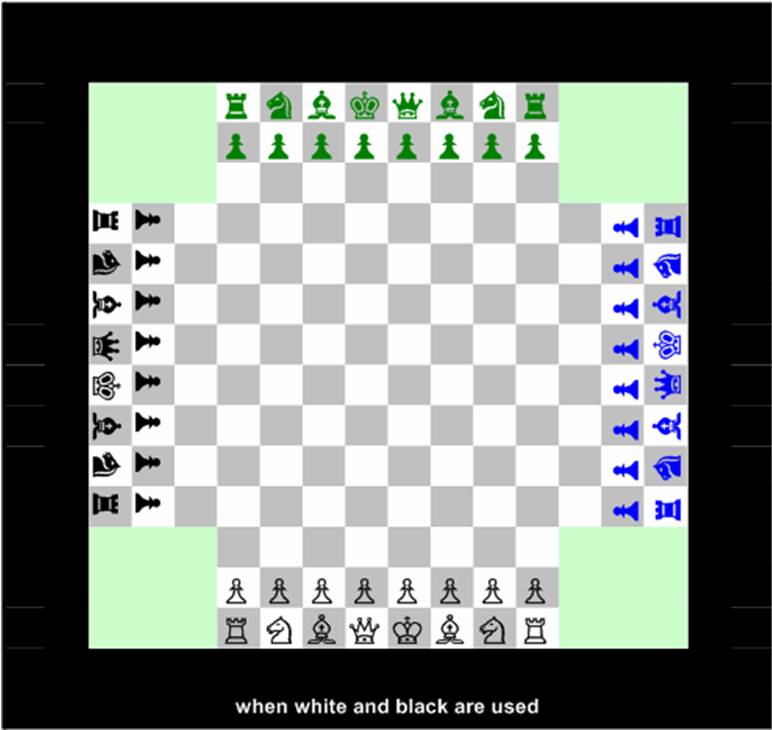
When White and Black colors are
used, they should be placed adjacent to each other, rather than across
from each other, in order to emphasize that the "enemy" is usually to the
left (and right), as depicted to the right >>.
BOARD COLORS
The board colors should be sufficiently
contrasting to aide the eye to differentiate rows, columns and diagonals.,
and still allow the pieces to stand out. |
 |
PLAY SEQUENCE
The players
pick who is to start. Because the first player has a perceived
advantage to win, each succeeding game should start with a different
player. Play can be clockwise or counter-clockwise. Successive
Games should alternate between clockwise and counter-clockwise play to
add new challenges for the players. The players should decide on
the play sequence before the game starts.
|
ALTERNATING CONFIGURATIONS
Players holding successive
marathons may want to alternate configurations so new strategies are
required in succeeding games. For example, queens on white, next
game queens on black, next game queens on left, next game queens on right,
and then repeat (configurations 1 and 2, above.) Remember to avoid
queens facing queen (configuration 3, above) as this configuration is
biased (unfair) in 4-player chess. The players may decide on how the
configurations should alternate before a marathon starts, or they can
allow whoever starts to declare the starting configuration.
|
|
RULES
All
standard chess rules apply as regards piece movement., except as
follows:
PAWNS
1.
Pawns advance in their column and capture on the diagonal, just as
in two-player chess. On
reaching its end row (its 14th row) the pawn may reverse its direction,
or be exchanged for another piece.
2. Pawns that manage to reach the end rows
of the players on their sides may also be exchanged for another piece
(such as a queen). It is generally difficult for a pawn to reach the
end row to the side because the only way a pawn can get to the side is by
shifting columns in capturing pieces.
EN PASSING:
The en-passing rule is the same as in two-player
chess, and can also occur with pawns coming in laterally from the side
players. The test is also the same -- if the passing pawn (only on
first move) could have been captured if only one move was made instead of
two, the passed pawn may capture it on his next move. If not taken
on the first opportunity, en passing is forfeited.
CHECK
A player may
move his king into a check. This is allowed because other players
may intervene, deliberately or inadvertently, to block or cancel a check.
It is very risky to deliberately risk a check, because an ally may
suddenly turn adversary, or not be successful in interceding. An
opponent may warn a player moving a king or queen into check, but it
is not required -- because his ally, if he has one, may also warn him .
CHECKMATE
A
checkmate is not the end game. A king must actually be captured and
removed from the board, at which time the
vanquished player ceases to be a player. This is necessary because the game does
not necessarily end on a checkmate. Allies and adversaries may
interfere and rescue the checkmated king --
attacking the checking positions and capturing or blocking a key
attacking piece. A player with a checkmated king may move any
of his pieces while his king is checkmated but not actually captured.
When a king is captured and
removed from the board, the defeated player's remaining pieces stay static
on the board, but may be captured and removed by any remaining player.
This is the default rule. Some players allow the player who captures
a king to take control of the captured king's pieces, and/or take the turn of
the defeated player. These are variant rules that must be declared and
agreed to before
the game starts.
WINNING
1. The last king
remaining is the winner, assuming the victorious king also attacks and
defeats his (former) allies or adversaries.
2. When any two kings remain, they may declare
an alliance
or truce and declare each other a winner. Or, they may fight on till the
death, even if they were former allies (old grudges
may surface which cause the remaining two remaining players to fight on.)
|
THREE PLAYERS
Three players on a four-player
chess board can be even more exciting and challenging them four players.
When playing with only three players, all four chess sets are on the
board. The players take turns moving the fourth set, so the fourth set
becomes extremely dangerous, becoming an ally on your move, but a very
unpredictable and dangerous opponent when its the other two player's
turns. The fourth set throws a monkey wrench into traditional
strategy.
|
|
Acquiring a
four-player chess set
There are only a few four-player chess sets being
marketed.
The
set to the right is a 24"
vinyl board set sold by Chess House with a 3-3/4" king with 1-1/2"
base and nicely weighted pieces. (http://www.chesshouse.com/Large_4_Player_Chess_Set_p/e081.htm)
for about $20, including extra queens.
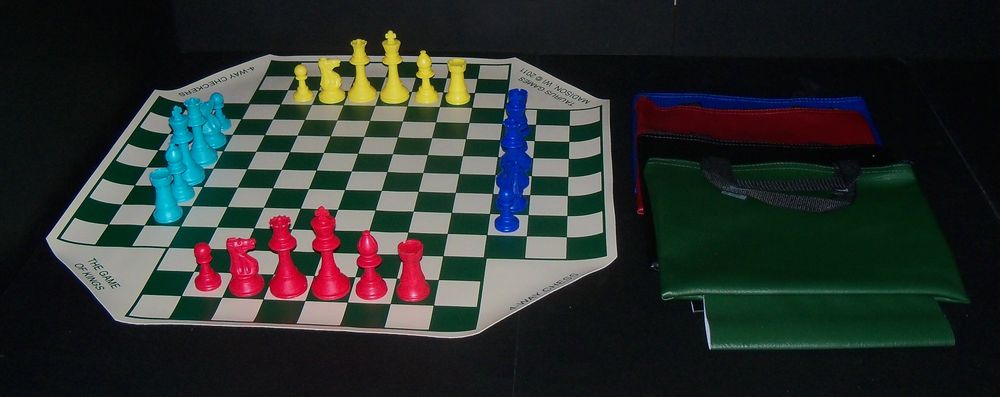
The set to the left is from American Chess Equipment (http://www.amchesseq.com/644chsetco.html) for $23.50,
also with a 24" vinyl board, including a storage bag, a 3-3/4"
king with 1-1/2" base, and nicely weighted pieces.
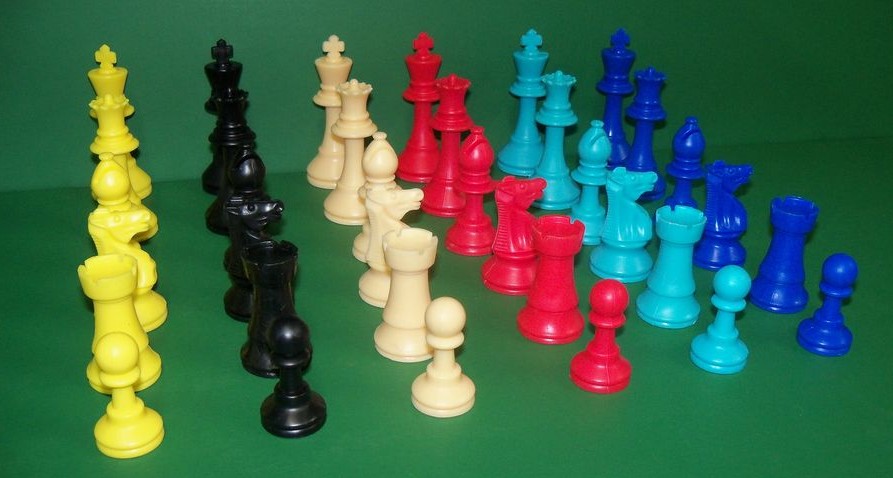
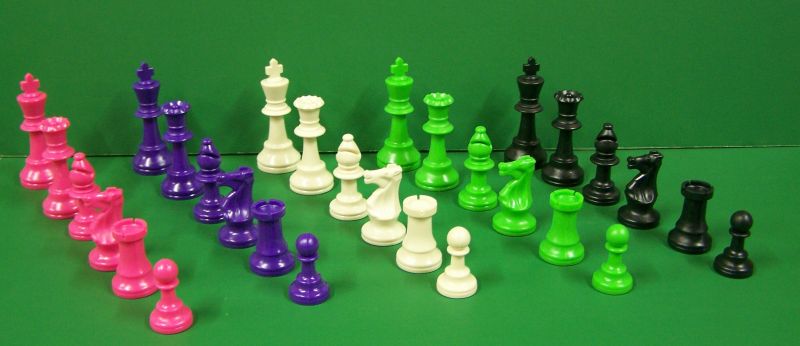
American Chess also sells just
the vinyl board for about $12, and different
color sets for about $5 for a 2-colors set.
You can make your own board from this
GIF image.
|
You may print out my rules and
distribute them, providing you don't charge a fee for them, and you
include the copyright.
|
|
©2010, 2011 Simon Revere Mouer III, PhD,
PE, all rights
reserve |
|